
Sextette (1978)
A girl who lost her reputation and never missed it...

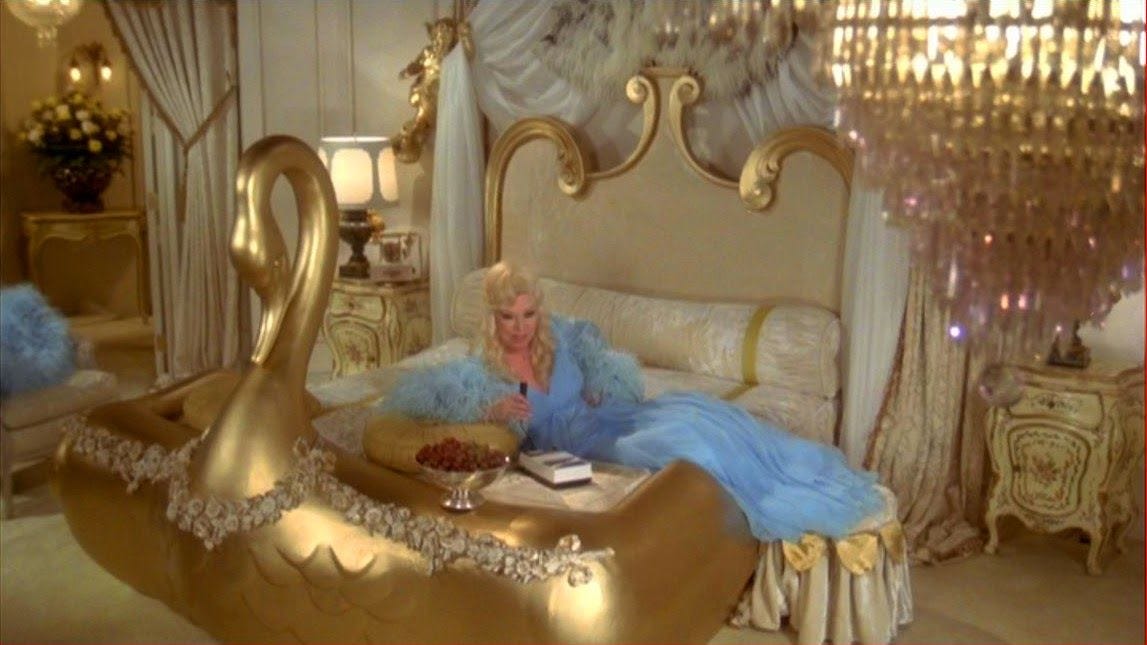
Sextette, if taken as a pun on sextet, could generously be interpreted as a movie that is a composite of six moving parts, characters, and situations that act independently from one another but aren’t interested in harmonizing. Movie star Marlo Manners (Mae West) marries a British Lord (Timothy Dalton) but is too busy running into her ex-husbands (there are five or six, she can’t remember), and with the demands of her acting career, to consummate their marriage. Meanwhile, her new husband keeps accidentally implying to a reporter that he’s gay (he tells her he feels ‘gay,’ but he means gay as in happy, not homosexual). The newlyweds are honeymooning at a hotel where there is a United Nations-type delegate conference happening, as well as the US Olympic team (unclear which one, but they appear to be gymnasts) training in the gym. There are disorienting, random musical numbers, a search for a cassette tape containing an audio of all of Marlo’s lurid secrets, and lots of costumes designed by Edith Head. In the end, Marlo Manners ensures world peace by threatening to expose her dalliances with various world delegates and agreeing to have one last encounter with her ex-husband/Russian delegate (Tony Curtis). Also, Mae West was eighty-six when she filmed this, while her co-star Timothy Dalton was thirty-two, but the film operates in a space-time continuum where they are the same age. It’s a film so delirious and scatterbrained that it feels impossible to dwell on any one ridiculous element, but Mae West’s age, though giving the film a different meaning than what was originally intended, is what most vexed most critics.
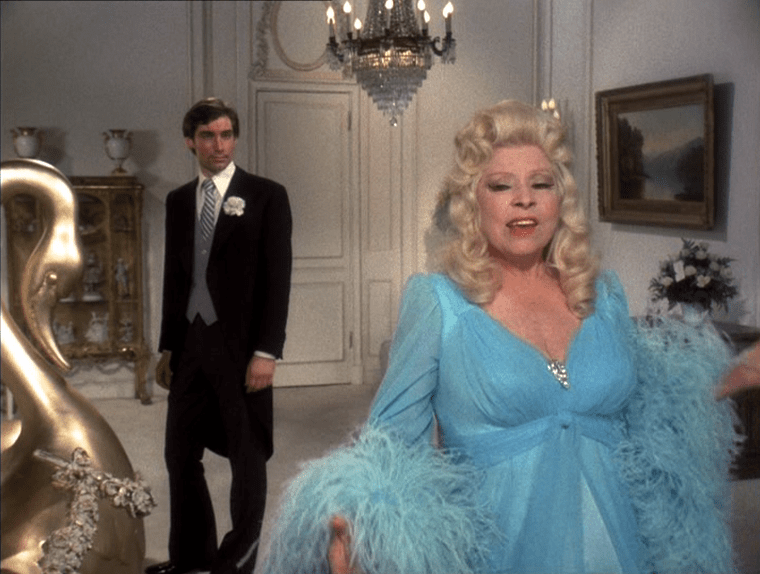
“Marriage is like a book; the whole story takes place between the covers.”
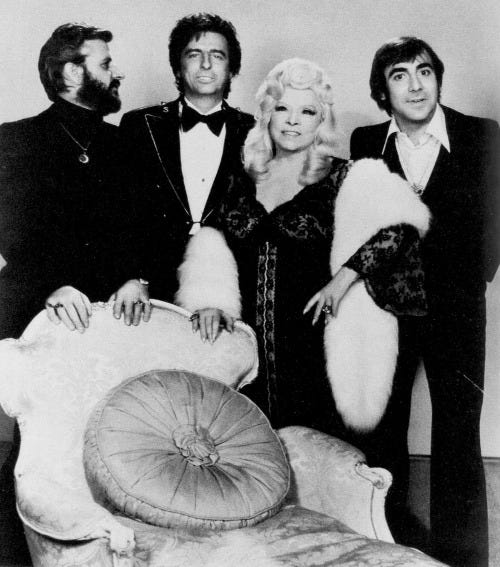
Where Sextette lacks in linearity it makes up for in guest cameos: Ringo Starr plays a crazed film director and one of Marlo’s ex-husbands; Alice Cooper plays a bellboy who serenades her; The Who’s Keith Moon plays her manic stylist (he died later that year); George Hamilton plays another one of her ex-husbands, a gangster wanted for murder; and her old co-star George Raft appears as himself in the elevator.
While Sextette may seem nonsensical, it’s more anachronistic. It attempts to mimic the screwball comedies from the 1930s and 1940s that were popular at the peak of Mae West’s fame but doesn’t translate as well in the context of late 1970s cinema, an era dominated by slow realist films. In one of Mae West’s early films, She Done Him Wrong, West plays a saloon singer who juggles three men (two criminals, one policeman (played by Cary Grant, whom West discovered)), accidentally stabs a woman, but nonetheless finds time to sing musical numbers in between all the drama.
Not a well-done movie in any traditional sense, yet decades in the making, Sextette has a prolonged and doomed backstory. Mae West originally wrote the story as a play in 1954, and it premiered in 1961 but never made it to Broadway. The lead actor, Jack Marshall, had a heart attack and died during a performance in Chicago and was replaced by Jack La Rue without any announcement to the audience. The film version sat in development from 1969-1976, lacking financial backing until Dan Briggs and Bob Sullivan, two young gay producers who were fans of Mae West and had family money, provided the funds needed for production.
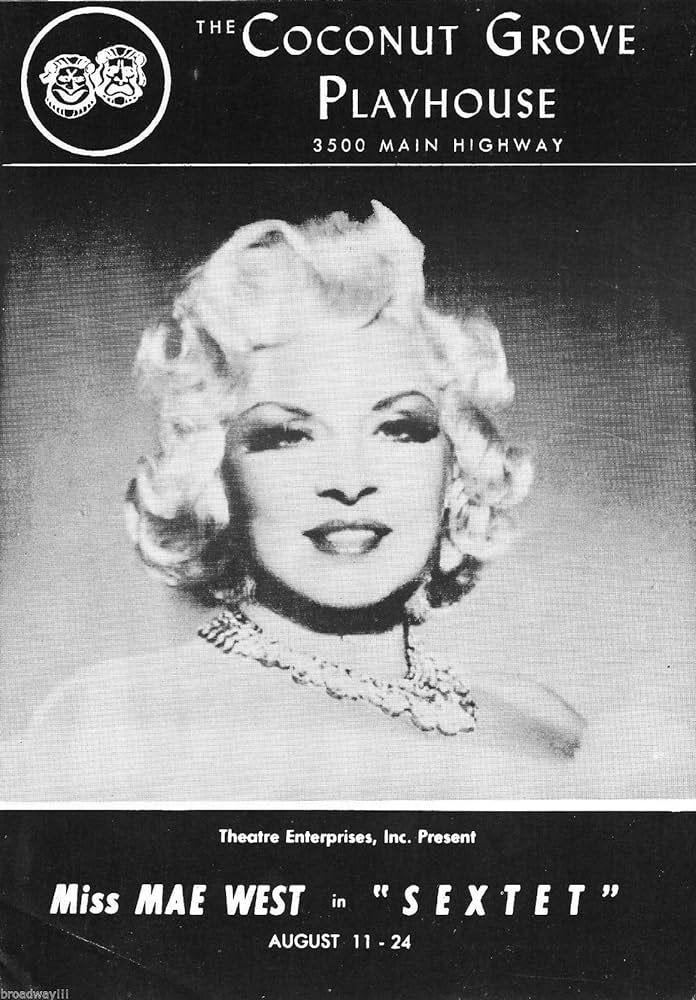
Playbill from 1961
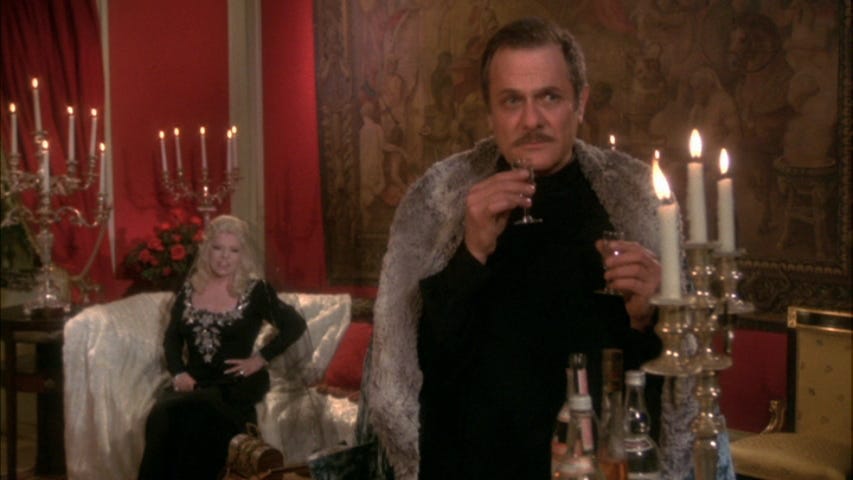
West and Tony Curtis
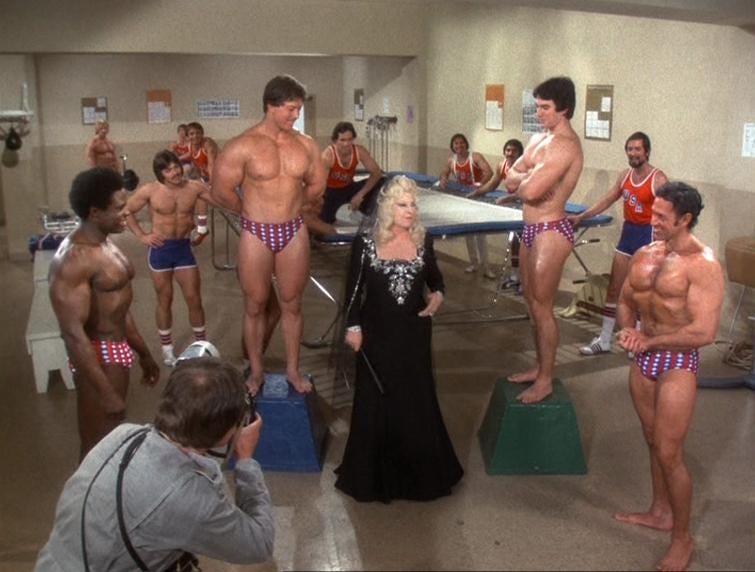
“Wow, all this meat and no potatoes.”
Sextette relies on the legend of Mae West for it to make the least bit of sense (though even without her, it would still be hysterically camp). It functions as a meta-tribute to West, a groundbreaking star of pre-code Hollywood, recycling her famous one-liners from 1930s films such as, “When I’m good I’m good, but when I’m bad, I’m better;” “I was once pure as the driven snow, but I drifted;” “Why don’t you come up and see me sometime?” It also includes lines West previously wrote for her films that were cut by censors like, “I’m the kind of girl who works at Paramount all day and Fox all night.” Sometimes, she speaks her notorious zingers without any context or dialogue prompting whatsoever. Previous versions of the script included direction to splice montages of clips from earlier Mae West films into Sextette, which would have made it even more of an homage, but the producers opted instead to show a fifteen-minute tribute to West at the beginning of the film’s premiere instead.
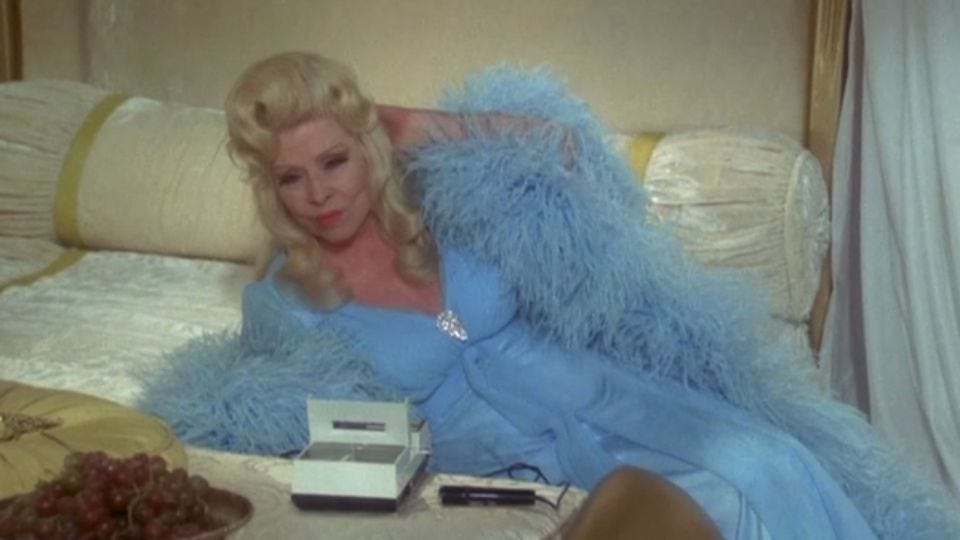
“Keep a diary and someday it’ll keep you.”
It usually takes years, or decades, for something— a film, an actress, a lamp— to classify as camp. In “Notes on Camp,” Susan Sontag wrote, “What was banal can, with the passage of time, become fantastic.” Mae West, though, has always been read as a pure camp spirit, with no affectation. She decided to become a performer at the age of seven, went into vaudeville at fourteen, and continued a career in film and on stage until she died in 1980 at the age of eighty-seven, shortly after this film was released. “Camp is the kinda comedy where they imitate me… Camp is being funny and dishy and outrageous and saying clever things. I’m always saying something sexy and funny” she said in a 1971 Playboy interview. Drag balls and gay culture were an early influence for West’s 1927 play The Drag, and arguably her persona and brand, but later in life drag queens began imitating her, and still do today, most notably on RuPaul’s Drag Race.
In the 1930s, it was rare for an aspiring movie star to come to Hollywood with their own preconceived notion of how they wanted to be branded. The studio system usually did that for them, but Mae West, having a background on Broadway and in playwriting, came into her movie career with not only a distinct character she wanted to play, but a character that had never appeared in the public consciousness before: a proud, smart, independent, sexually forward woman—not vampy, evil, or fallen—but unapologetic about her desires. West even kept her Brooklyn accent. She was Paramount’s highest paid actress, earning at her request $1 more than the president.
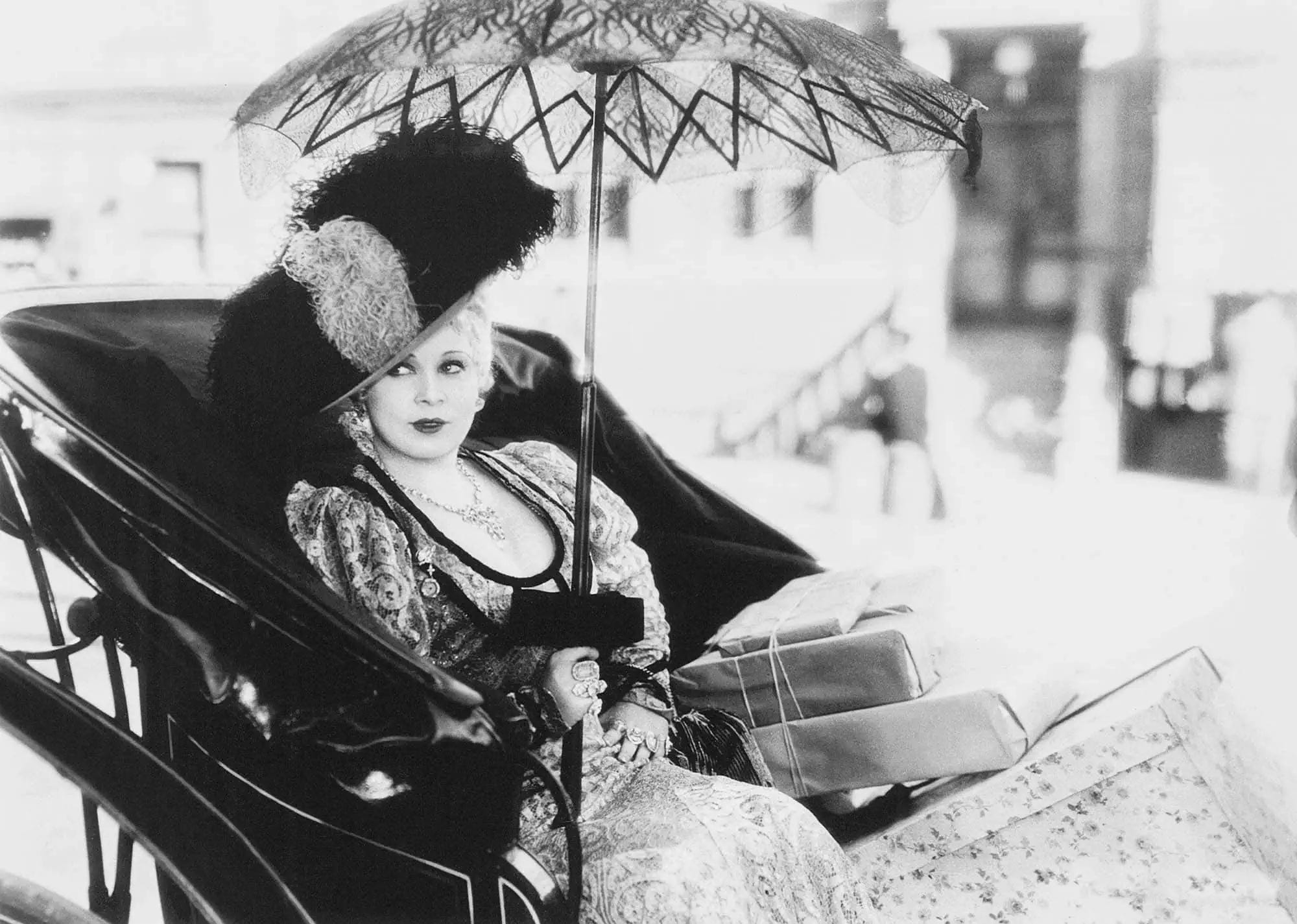
“I’m the kind of girl who works at Paramount all Day and Fox all night.”
Though the general American public was wary of hyper-sexualized women, West’s sexuality wasn’t one that was overtly threatening. It wasn’t deviant; she said she never played “home-wreckers.” Bawdy and exaggerated, her sexuality relied on her wit, openness, and confidence. It did not, in the vein of sex symbols who were her contemporaries such as Jean Harlow, rely on her youth (she was 40 when she made her first film), or fitting the Jazz Age style of the time. Most of her plays and films were period pieces in which she was elaborately covered up. West said, “If I posed in the nude, I’d lose a lot of my audience. Nudity becomes monotonous. And besides, if you don’t have a sensational-looking body, what’s the point?” Rather, West piled on the costumes: floor length gowns; rings on every finger; diamonds; pearls; furs; feathers; hats; gloves; and parasols. Initially, her Broadway plays appealed more to straight men, but then West realized that if she incorporated more fashion into her roles, she would gain more female fans, which she did. Her persona was from the beginning so very camp that young girls would even dress up as her for Halloween.
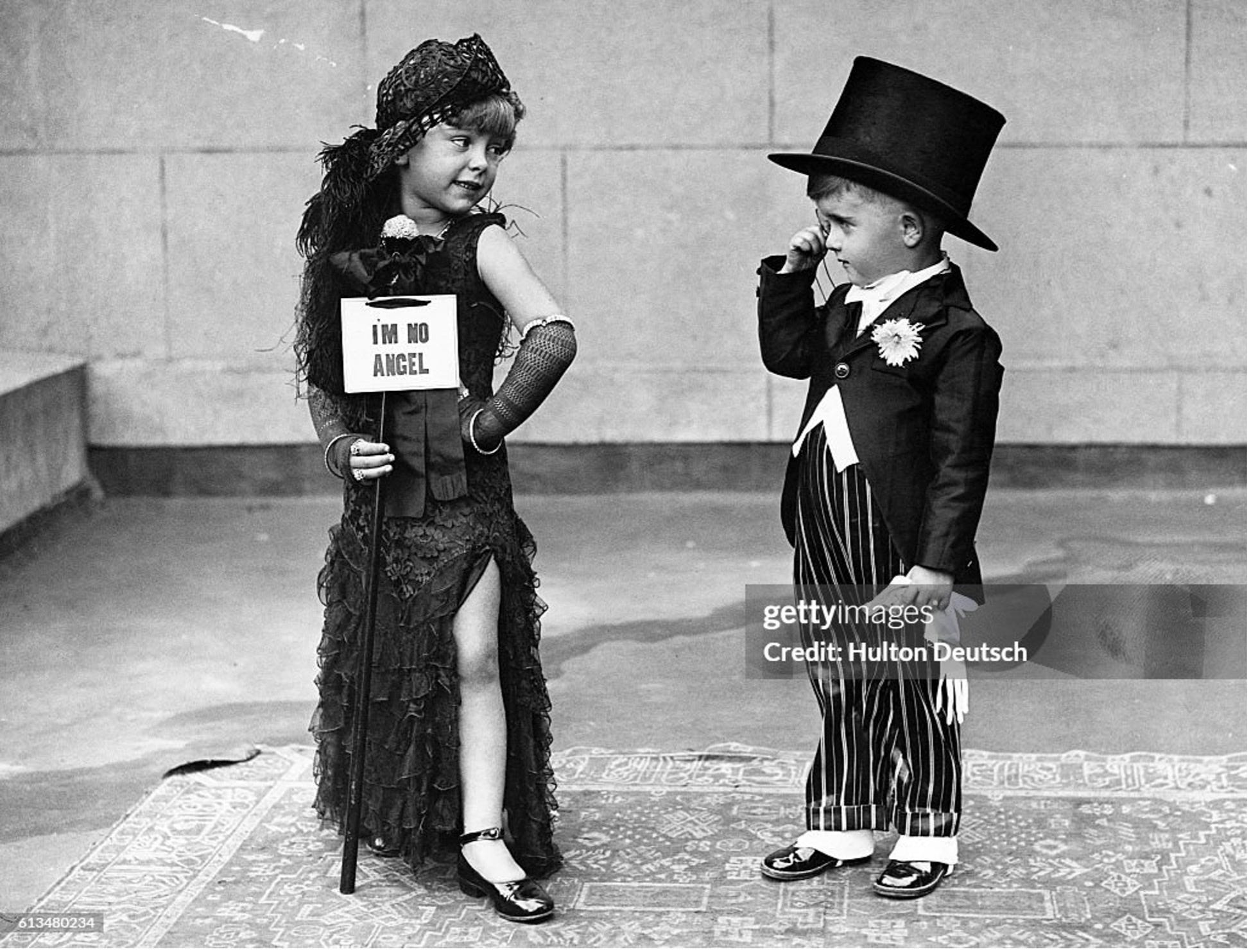
West made ten films from 1933-1943, eight of which she also wrote or co-wrote. “You don’t want to saturate the public. It’s important to make them want you,” she once remarked, but the reason for her departure from film was mainly due to censorship and lack of creative control. Mae West only wanted to play Mae West, written by Mae West. She did not make any films from 1943-1970, and instead worked in theatre and in clubs, including a Las Vegas stage show where she performed with muscle men. She rejected the role of Norma Desmond in Sunset Boulevard in 1950, calling it “pure pathos,” and declined offers from Federico Fellini for roles in Juliet of the Spirits and Satyricon. West returned to film in 1970 to play a talent agent who seduces her young male clients in Myra Breckenridge. Almost thirty years had passed, but because West played a supporting role and the movie was such an unhinged, aggressively camp mess for reasons unrelated to Mae West’s age, critics weren’t as unkind with her when reviewing Myra Breckenridge as they were with Sextette.
The reactions to Sextette from film critics say more about the film than the film has to say about itself. Though all critics at the time agreed it was not a good movie, some found it entertaining and others cringeworthy. The reaction was generally divided by the film critics’ age and sexuality— young gay men loved it; old straight men hated it. The prevailing knee-jerk response from film critics was to mock West for being in her late eighties and the film for pretending she is much younger.
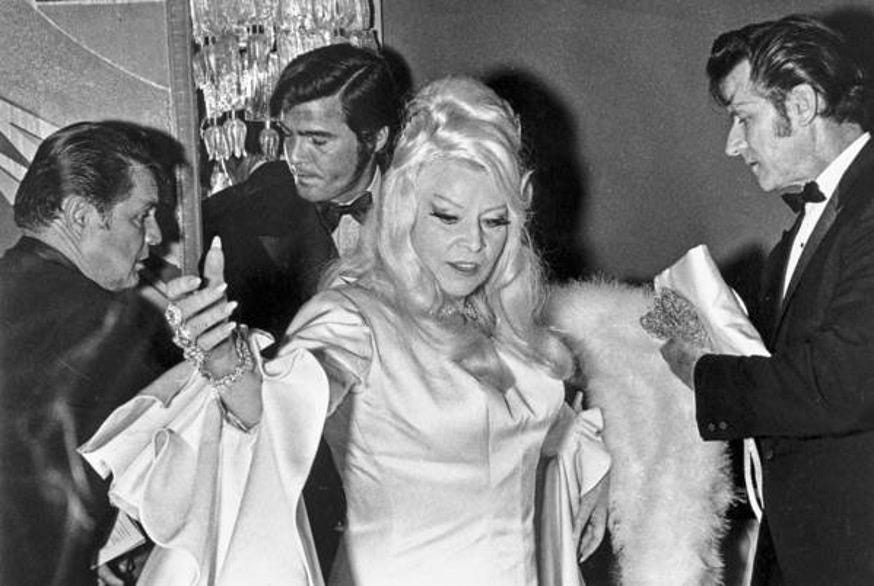
An excerpt from New York Times film critic Vincent Canby’s vituperative review:
“Sextette is a disorienting freakshow in which Mae West, now 87 years old, does a frail imitation of the personality that wasn’t all that interesting 45 years ago… The character we see in this particular film looks less like the Mae West one remembers from even Myra Breckenridge than like a plump sheep that’s been stood up on its hind legs dressed in a drag queen’s idea of chic, bewigged and then smeared with pink plaster. The creature inside this getup seems game but arthritic and perplexed. She walks with apparent difficulty. One eye sometimes sags, and the voice despite Hollywood’s electronic skills, cracks like the voice of the old lady she is. Under these circumstances, the sexual innuendos are embarrassing. Granny should have her mouth washed out with soap, along with her teeth.”
Rex Reed, film critic for the New York Observer who ironically starred with West in Myra Breckenridge a few years prior, called Sextette “a total, unbearable bomb, more like a training film for retired French whores than anything else.”
In her early career, West reportedly had a clause in her contract that she wouldn’t play anyone older than twenty-eight, and in most of her films her age was simply never mentioned, leaving the viewer to make their own assumptions with no harm done to West’s ego. With Sextette, though, this omission feels more deliberate; the film implores the audience to participate in this delusion, which some people are more willing to do than others. “In their haste to denounce this picture, Mae’s detractors conveniently overlook the fact that it is a farce… I can’t understand why people are so determined not to have a good time,” Scott Cain wrote in the Atlanta Journal.
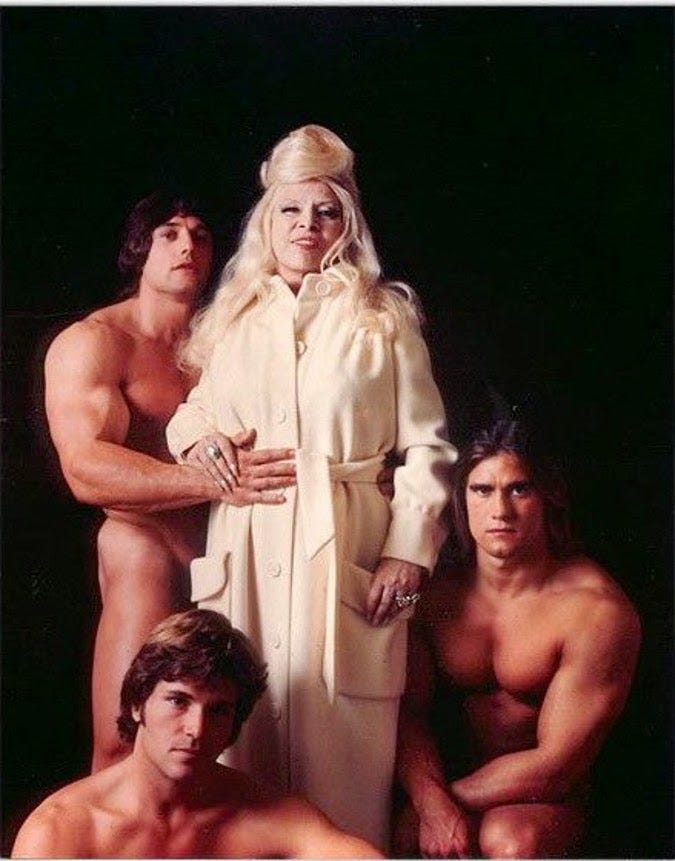
Sextette, perhaps for championing Mae West’s perceived age dysphoria, produced existential dread for some critics. Vincent Canby wrote, “The movie… is a poetic, terrifying reminder of how a virtually disembodied ego can survive total physical decay and loss of common sense.” A critic from Film Authority recently wrote, “It burns its way into your consciousness, leaving you changed inside forever, wrestling with questions of your own mortality.”
If this movie leaves viewers wrestling with questions of their own mortality, perhaps that is more a reflection on how they already feel about aging, in particular about women aging. West’s performance in this film, as with all her other films, is life-affirming. Her personality was always both young, in that she never seemed weighed down by life, and old, in that she said whatever the hell she wanted as though she might die in a week.
It’s not the explicitness of the film that bothered people. Sextette, despite it’s title, is PG-rated. Mae West doesn’t have sex, she only jokes about sex, using the same carefree wordplay she always did. “It’s not what I say but how I say it” was one of her characteristic chiasmuses. Whether the audience applauds this as empowering or shirks in revulsion, West likely didn’t care about how her age would affect her performance. She didn’t ever care that her sexuality made people uncomfortable; she didn’t even think about it at all. It’s this nonchalance and unwavering commitment to feeling good about oneself, along with an innate ability to deliver a well-timed joke, that creates a lasting sex appeal beyond what youth or inherent beauty can provide.
Subtitle, captions: Mae West-isms
Sextette: High Femme, High Camp
I'm going to have to watch this film!